I promised doggie pictures, and I keep my promises.
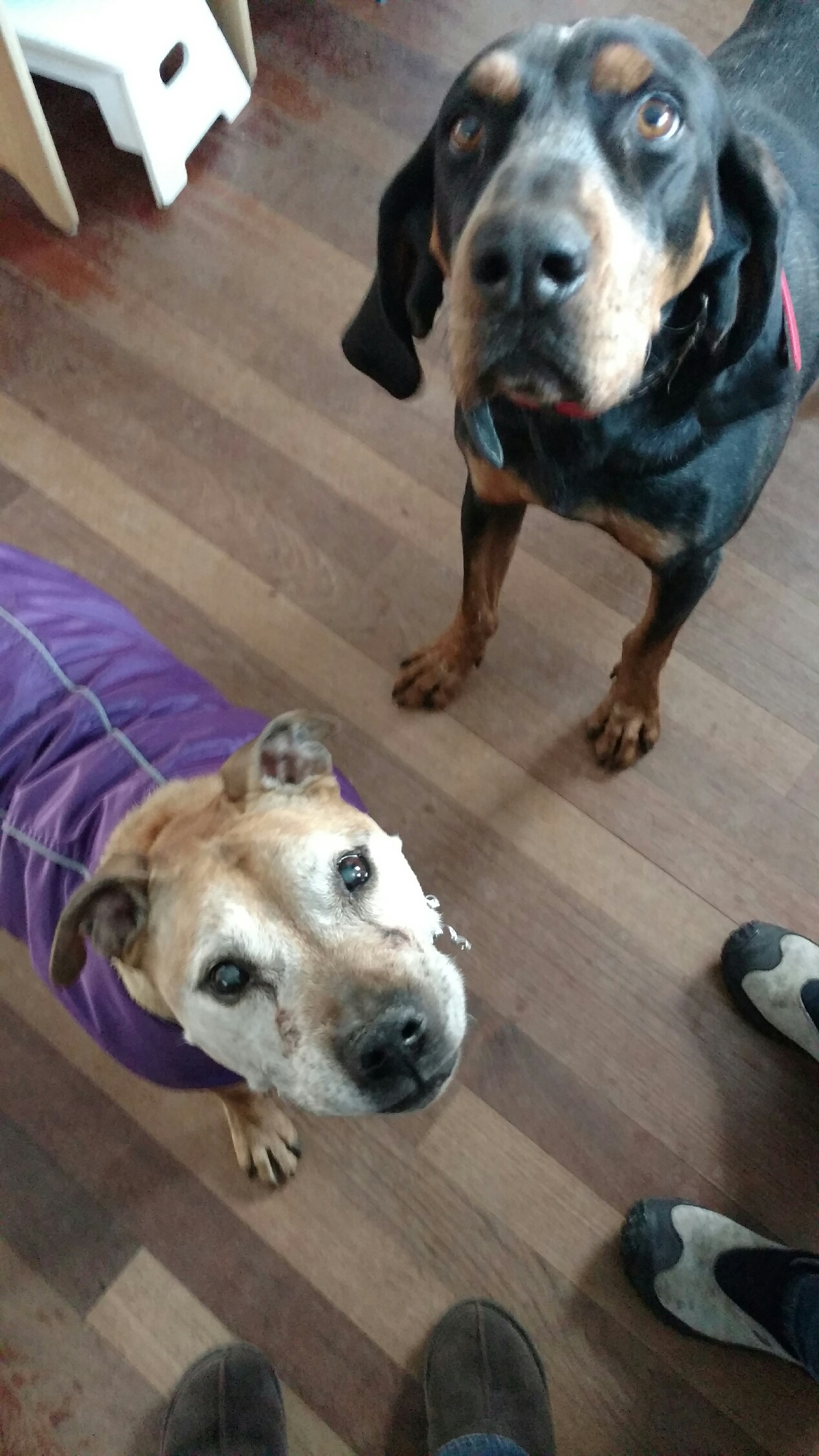
I promised doggie pictures, and I keep my promises.
(Presented in clickbait-friendly list form. I expectantly await a concomitant surge in readership. It’s too bad I don’t take advertising.)
1. Having three weeks of pieces scheduled (the two weeks of sabbatical and all of last week as well, to prevent coming off sabbatical and finding myself immediately behind the eight ball) felt great. My stress levels fell, my days felt wonderfully open, and my vision of how I might focus my writing got both clearer and more expansive.
That settles it. I will make this kind of forward preparation into a habit, a practice.
2. My sabbatical rule was that I didn’t have to write, not that I couldn’t. Nevertheless, when the time came, I chose to reject the writing urge, thinking that doing so might prove deeply recharging at the end of my weeks off. It worked. I had no problem at all staying comfortably on top of my drafting last week. It was easy, and I found myself working on more ambitious pieces than I do when I have imminent deadlines.
3. I didn’t write, but I did scribble down the myriad ideas that came to me, ideas that tended to be substantial. I see the potential for a great deal of exploration within those ideas, and I’m excited to dive into them.
Last year, my piece about wintertime goals was focused primarily on sports- and health-related objectives while keeping my focus on the need to stay in touch with the energy of the season. I aimed to stay healthy and uninjured. I pledged to ski with less stress and more flow.
With respect to my sports endeavors, I’ll declare similar goals this year. Staying healthy and uninjured, and the consciousness of the body’s needs that that requires, is a good goal. I struggled enough with injury in 2016, particularly that torn hamstring back in May, that I don’t want to suffer similar in 2017.
If you’ve been following TTW since the election, you’ve seen that our focus has expanded since then. The depth of anguish over the past two months has convinced us we need to actively connect our practices to the bigger picture in our lives. With that in mind, what might my goals look like for winter of 2017?
As I write this in mid-December, I haven’t yet taught a lesson this season. By the time it’s published I will have taught many. My students tend to be from all over the country. If last season is any indication, politics will not be spoken of much during our chairlift conversations, but I will probably get some idea that what people are going through is different from last year.
I want to be able to hold this space for my students. I want to find a way to broach or at least acknowledge that things are pretty challenging in our world right now. That the election seems to have thrown a lot of people off, irrespective of their particular political bent. I want to learn to speak more comfortably about the energetic aspects of what’s going on, and to tune people in to ways of dealing with it. I’ll be standing on a mountain as I do so, so I’ve got a pretty solid chunk of ground to teach grounding.
I also want to explore how to make things easier. A goal needs to be measurable if you want it to be an effective guide to behavior, and right now I don’t know how you measure easier. When I experience it, I certainly know it. In skiing, in snowboarding, in tennis and golf and soccer (when the weather rolls back around to allow those activities), I want to do what I do easier than I have done.
An exploration of cultivating ease will be something I will practice, and something I will to bring to my students this winter. People need it. We’re pretty addicted in our culture to making things hard. And it’s not serving us.
What I did yesterday? Publishing here the first paragraph from the first draft from what will be my first novel? That was a statement of intent. And damn it felt good.
The grey sky loomed close to the treetops and sighed out endless rain. The rain drummed restless fingertips on the green leaves, the ground, the roof, everything. It was morning but dark as twilight. John looked out from the front window of his apartment at the underwater world. He stood there for a long time.
With my sabbatical over, I can now really entertain my thoughts about the things that I’ve set down that I might pick up anew or in new ways for 2017. And one of them is going to be my unfinished novel, the one of the five that I want to be my first finished novel. I put it on a shelf years ago because when I read over what I had I didn’t see the thing working. And maybe it doesn’t work. Or rather, won’t work. But I’m going to finish it anyway, regardless. Remember how last week I said I was going to put down any remaining idea that I need to be perfect?
I recently stumbled across this sentence in a zero draft from a while back, a note I wrote to myself in a place where I was struggling with fear about my writing:
OR I COULD TRUST THAT I HAVE A VOICE AND SOMETHING TO SAY WITH IT.
One of my goals in life is to change the world. No big deal, right? Simple.
I don’t mean to aggrandize my role. A lot of people feel that way, I think. And many of us, it appears, give up. We make change so hard, which is really strange, because change is literally the most natural thing in the entire universe. It may even be more accurate to say that change is the universe. Moment by moment, nothing stays the same. Nothing. And yet we attach so hard to keeping things as they are. Strange. I wonder where that tendency came from.
I don’t think change has to be that hard. There are things that need to change. We don’t have to figure out all of these things individually, though. We can just notice the things we notice. We’ll feel an impulse. It must happen to people all the time. We notice something in the world that isn’t working as well as it could be. We imagine something better. But then all too often we ignore that impulse. It’s so hard to change the world, we think.
But it starts just like that, that imagination of how it might work better.
To begin to bring that change into fruition, I’m going to give you an incantation that calls in magic. Find that thing that isn’t working as well as it should. Describe it, first to yourself, later to someone else. Describe how it isn’t working. Now you have arrived at the moment of beginning. Say these words:
“I have a better idea.”
In myriad ways, I codify the energy of the season into my behavior. I am working quite a bit teaching skiing these days, but I observe that my relationship with the mountain in winter supports my energy. I am outside in the crisp cold air during the day. But as night falls I go home, eat dinner, do little of anything else. I go to sleep early.
With respect to my vocation, writing, I express the energy of the season by taking a sabbatical. My goal is to do no writing work of any sort during the two weeks around the solstice, the last two weeks of the calendar year, our culture’s holiday period.
So while I am working, I am still resting. The mountain supports my energy while I’m teaching. At night, in the morning, the computer will often stay off. I’m not reading drafts, I’m not revising, I’m not writing anything new. The closest I get to writing is in reading the writing of others. Some nights I sit by the fire and exult in the pleasure of the written word without demanding anything of myself except, as best I am able, a return to the pleasure writing gave me when I was a young boy, so many years ago.
I’m as quiet as I can be during this period. Thus I respect the energy of the season by respecting the intention of my sabbatical. And when the new year awakens in a few days, I can meet it with renewed vigor.
I’ve been scheduled to teach skiing this whole week. I’m never guaranteed a lesson, so I go in to work not knowing if I’ll be getting to work or not. If I don’t, I’m free to go ski, but it’s busy right now. The week after Christmas is one of the mountain’s busiest times.
So it’s not quiet, in other words. It can seem like there’s a lot of turbulence, what with the crowds and the getting in to work and the lessons or sometimes, maybe, the standing there until I’m dismissed.
But whatever turbulence there is, it’s just on the surface. Below it is the mountain itself, placid as … well, as placid as a mountain is. We intrude on its consciousness to about the same extent as individual motes of dust intrude on ours.
I told you I practiced putting things down this sabbatical. And I admitted I have a tendecy to pick things back up when I’m not paying attention.
I’m not making it hard, though. I just put that stuff down again. It’s easy to tap back into an energy of quiet and ease when I get to stand on a mountain all day.
[from zd/2016/1214.sabbatical_2nd_week]
There are (at least) two new years, you know. The true new year is the winter solstice. And then there is the calendar new year, which is the one we make a big deal about. We want it to be magical and perfect and it’s almost always a let down.
The former is the one that matters more to me. The other is a cultural artifact that’s significant only because we choose to believe it’s significant. The solstice is measurable, a physical reality. “January 1st” is just an idea, though a persistent one, one that there’s no sense in fighting.
So I make something of a compromise. These days, I try to keep things really quiet from the solstice through January 1st. I take my writing sabbatical. I disengage as much as I can from the holidays without hurting feelings. And though the baby that is the new year was born on the solstice, I try to just let it sleep until we flip the calendar. Put another way: this year’s sabbatical theme is “putting things down.” Already I’m thinking of what I’m going to pick back up. I can’t really help it, but for now I try to let that stuff go. “Shhh,” I say to myself. “You’re going to wake the baby.”
But I really can let it sleep for a while. The baby will wake up soon enough.