On the Vernal Equinox, 2017 (Part 2)

When you are accustomed to seeing who you are as a problem, it can be pretty challenging to make choices that make you happy. Happiness seems suspect, as though corrupted.

We call this emotion shame.

Consequently, if you do what you are called to do, you do it without joy, or mostly so, except for those occasional times when the voices stop and you dissolve into the work itself. On those days the words come like surfing the terrain on a powder day, where it’s less like you are going down the mountain than that the mountain is coming up to meet you, and you are at the center of everything.

Those times are beautiful, but they tend to slip through our fingers like the finest sand, because somewhere we learned that we have to suffer to make art. We are called to make art, so goddamn it we are going to make art. And so we suffer.

There comes a time, though, when struggle just gets boring.

So we decide, Fuck it, I’m just going to be happy. I’m going to make the choices I need to make to make me happy. And if my life blows up: okay. Okay. I’m willing. I’ve been through worse. I have been to the darkest places.

I carry a refuge within me: I can always escape into the present. I will dive as deeply as necessary into it. I will slow down time to feel each exquisite moment of anguish if necessary, to examine what feels like flatline and discover that slow vibrations, barely perceptible, remain. Look close enough and you discover that the oscillations always continue. What that says to us: This too shall pass, just like this moment, and this one, and this one.

And now after years of practice, I know that I have another refuge available: I have the work itself. No one can take that away from me. Even in the darkest days, even when all went wrong, the work was always there. And when I came back to it from off the bottom and learned to show up despite that I couldn’t allow it to make me happy– because happiness is suspect, remember–well, seriously, there’s no way I’m going to stop doing it now. This is who I am. I did it: there’s no question anymore. I need no external validation.

That said, I do this daily dance with words as a means to connect with people.

And earning a nice, regular paycheck from this work would feel really good.
On the Vernal Equinox, 2017

Two years ago today, I began my weekday publishing practice here on Free Refills with a piece entitled, “Planting a Seed.

I did it because it was time. I had been called, years before, with an insight: The Internet changes everything. In the new world, you don’t need anyone’s permission. You do the work. You write, and you publish. You don’t need to declare yourself to be a writer. You do the work, and the work does it for you.

Two years ago today, I truly began to answer that call.

“By changing the boundaries under which the game is played,” I said, “you change the game itself.”

I made a promise, to myself and to all who were there to see it. I promised I would publish a new piece of writing every weekday, backed every week by 5,000 words of drafting.

“Today is the equinox,” I said, “and right here I am planting a seed.”

I would publish every weekday like it was my job. I would publish every weekday because it was my job. In two years–more than 520 pieces now–I have never missed my daily deadline.

What I did not do was tell the world about it. I felt I needed a clearer idea of what I was doing before I began to share it. So far I’m just writing about the process, I told myself. Who is going to find that kind of thing interesting?

The last sentence of that first piece was this: “I still don’t know what exactly is going to sprout.”

In recent weeks I have read over those earliest pieces, and two years on, I have the perspective to see what I was doing there. Those pieces coherently tell the story of the early days of this experiment. They teach. And they are very, very good.

Who’s going to care about pieces about process? Over recent weeks, I’ve come to a new understanding of that question. I’ve started to find my way to something that can only be called faith. I long ago came to understand that the best work happens when I get my ego out of the way and just allow what needs to come through to come through. The universe asks me to become a channel, and I allow it happen. The faith, though, is this: the universe doesn’t play tricks. If you’re called to speak, the universe will bring ears to listen.

(From TTW) On Proposition 5

Proposition 5: Hyper-partisanship is not just making things worse, it’s leading inexorably to the collapse of the current system.

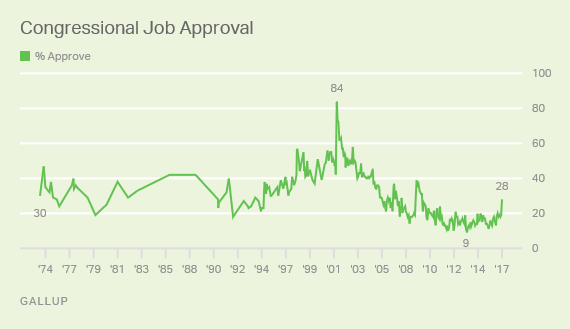
I acknowledge that worse is somewhat in the eye of the beholder, but let’s use this chart of Congressional job approval ratings to make the argument. (This chart comes from Gallup, the polling company.)

Let’s start our discussion in 1992. Through the Clinton presidency, Congress’s approval ratings trended upwards. Notice the substantial spike after 1994, which was the election that brought us the Gingrich revolution and really began the era of deep partisan divide in Congress. I propose two reasons for that upward trend. One was the economic boom of the ’90s–when people see improvements in their lives, they are more likely to see the government in favorable terms. But the other was in fact the partisanship that Gingrich brought with him, as highlighted, ultimately, by the Lewinsky scandal and Clinton’s impeachment. Initially, and contrary to my thesis, people liked partisanship. What changed?

The boom ended, that’s what. The boom itself was essentially extra-governmental. It arose via the first wave of efficiencies wrought by the Internet. Thus the partisanship of the ’90s was essentially a sideshow. But then the boom ended, and we returned to a situation in which we needed a functioning government to make things better for people. And the government has increasingly failed to do so. You can see that failure in the trends of Congressional approval ratings since the end of the Clinton presidency.

If we discount the peak right after September 11, 2001, the trend was strongly downward throughout the George W. Bush administration, rose sharply but briefly at the start of the Obama administration, fell to news lows as that administration went on, and now has risen again–all the way to 28% approval!–at the start of the Trump administration. I predict the bump upward will be as short-lived as it was at the start of the Obama administration, and we’ll soon see Congressional approval fall to new lows.

Conflict is not a path to creation.

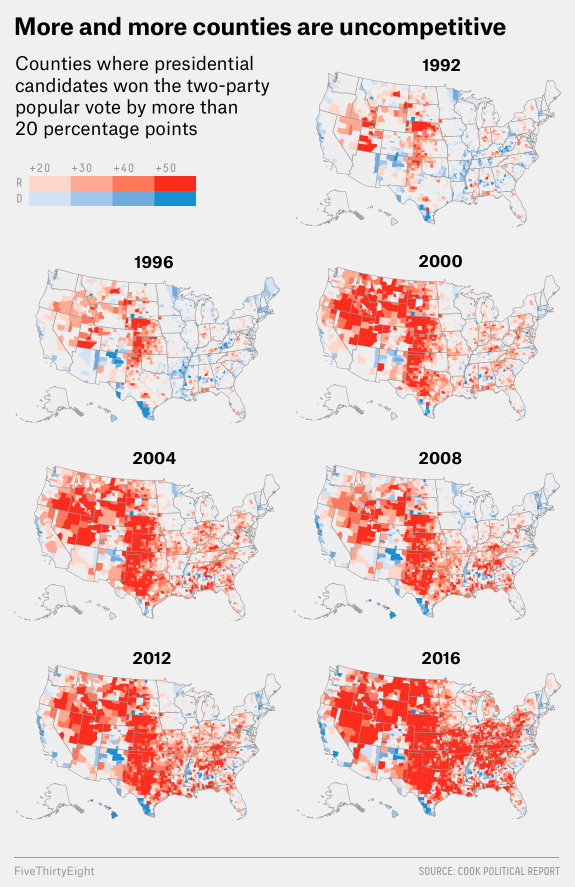
So if partisanship has not led to outcomes people like, is there any sign that the trend toward partisanship is abating? In fact, just the opposite is happening. Check out this graphic showing how the electoral results across America are getting more and more polarized:

(For more discussion of this graphic and the underlying phenomenon, please see Purple America Has All But Disappeared on fivethirtyeight.com.)

So: partisanship is making things worse, and partisanship is increasing. Only time will tell if the second half of my proposition is accurate. But I propose that increasing partisanship and worsening results from the system form a feedback loop. Extreme partisanship leads to a Congress (and therefore government in general) unable to get anything done, which leads to disgust with the system and deeper distrust of the other side, whom each side respectively blames for everything that isn’t working, which leads to deeper partisanship, and so on.

There’s a limit to how much a system can degrade before it collapses. Once a feedback loop gets set into place, it will grow and grow and grow until something comes along to arrest it. Do you see any evidence that anything is going to do that with respect to our system? Any at all?

Reflections–the Best Reflections–on an Excellent Week

Now that we’re at Thursday, let us reflect on everything we’ve accomplished at Free Refills this week. On Sunday night, we found ourselves facing a very busy week that would largely keep us away from the computer, an empty queue of ready-to-publish pieces, and no real ideas for how to proceed. Then we began to zero draft, still with no ideas but running with who-knows-where-it-came-from impulse that it might be fun to play around with the weird superlatives that pepper the speech of the person most people agree that most people agree is our president, which is to say he occupies the White House and does, sort of, the president’s job. And now consider what a terrific set of pieces we’ve been able to write via linguistic contortions, self-circularity, and no ideas except playing with that language. We’ve come up with a week of pieces that everyone agrees is pretty much genius, and those hideously un-American people who don’t agree that everyone agrees that these are terrific pieces, really the best pieces, probably feel amused anyway, and when even the people who don’t agree smile and chuckle and thus are forced to agree, then they really must be the best pieces, which also forces them to agree.

They’re forced to agree or we’ll deport their undiscerning asses back where they came from, and by that I don’t mean spatially, since many of them are from here, and also because Free Refills refuses to even appear to countenance the racism implicit in the anti-immigrant rhetoric of the current administration, but instead temporally, back to a time where there’s no internet and no concept of an internet, and then they’ll woefully agree that when the internet does finally get invented, a terrific site, really the best side, was/will be this one site called Free Refills.

Should have agreed all along, eh, Time Traveler? Enjoy your bubonic plague, Time Traveler.

Everyone Agrees

Now after yesterday’s piece you have to admit I’m on something of a roll. It’s sort of weirdly self-referential to assert that these pieces in which I assert that I’m doing really great work (I mean the best work, work that everyone agrees is really terrific work) are themselves the best work. But they are. Millions of people are reading them right now. And I mean right now. Right now, as you are reading this, there are like a million other people reading these pieces as well. Can you feel the resonance of your minds, working together? It’s pretty intense, when you think about it. All these people around the world reading these words at the same time you are and, exactly as you are, agreeing that this is really terrific writing. The best writing. And the best website in the whole world. Everyone reading this right now agrees.

Another Way, Possibly Pathological, of Saying What I Said Yesterday

I’m doing such good work right now. Really good work. The best work. Everyone agrees. You should see my drafts! “Damn!” you’d say. “This is really the best work!”

Yesterday’s piece got, like, a billion hits. The most hits. Servers totally unrelated to the one(s) that host my site crashed from the load. Servers in different states. Different dimensions, even. Because I’m doing such good work and everyone recognizes it.

Examples of a Growing Faith

We’re in the final week of season eight of the Free Refills project. A week from today will mark the two-year anniversary of the project’s true beginning. How about that, eh? Things have been changing around here for a while now–you’ve noticed, I assume–but the pace of that change will be accelerating.

If you’re a longtime reader, you have seen me at times suggest that maybe what I’m writing isn’t for everyone. More accurately, you’ve seen me say that like it’s a problem.

Well let me first of all say that no writer’s work appeals to everybody. I’ve seen writers whom I admire disparage publicly the work of the guy whose writing flipped the switch inside my heart that made me say, “I want to try to do that.” A benefit of excellent writers feeling inspired to flip the metaphorical bird at someone who literally altered the course of my life is that the pressure is surely off me. That guy was a fucking genius, and some very smart people hate his work. Lord knows I don’t have to try to please everybody.

So I’m done worrying about it. If my work speaks to you, fine. If it doesn’t, also fine.

I have a voice, and I have something to say with it. The universe doesn’t play tricks on us. If you’re called to speak, the universe will bring ears to listen.

(From TTW) On Observation 4: The Growing Awareness that Something Is Amiss

Observation 4: There’s a growing awareness that something is deeply amiss, that our problems run deeper than just who’s currently in office.

It was this observation that really drove Jerry and me to shift the focus of TTW from exploring using energetics and flow in the realm of sports to connecting with what we were witnessing happen in the political realm and throughout our society as a whole. We did not and do not see what happened in 2016 as just another election. The cultural currents at play are far deeper and more powerful.

I strive to be as non-partisan as I am able in these writings, so I apologize if this alienates you, but what Trump supported and stood for was problematic. He displayed deeply sexist tendencies. His immigration policies were built, at best, on deep xenophobia, if not outright racism. His “drain the swamp” rhetoric spoke, perhaps not unreasonably, to voters who felt that the problems we face are inherent in Washington itself, but in extending that rhetoric to attacks on the press, he inhabits a space usually held by despots and dictators. There’s a reason freedom of the press is contained in the First Amendment: a free press is a core value of our country.

Some of Trump’s support came from people who felt empowered by his uglier side. But I maintain that the vast majority of people are decent, and decent people who voted for Trump surely did so with substantial reservations. But for the many Trump voters who feel that the system is no longer working, the choice to vote for someone so hostile to the system itself was sort of a last-gasp attempt to force the system to change, instead of having to throw the whole thing away and start over.

But as we witness the chaos of Trump’s first seven weeks in office, it’s clear that the jolt Trump delivered to the system can only ever serve a negative purpose. By identifying and speaking to the problems driving populist revolt, he found himself in the White House. But he offers no positive answers. He’s a destroyer, not a creator. (Don’t think so? Consider that what he’s most famous for as a celebrity is nothing he created but rather his catchphrase: “You’re fired.”)

The collapse of the system is only accelerating. But I get the sense that few Trump voters are regretting choosing him instead of Clinton. They threw up a hail-mary in the hopes that the system’s dysfunction could be arrested. It’s not working and it’s not going to work. So if the answer to the question, “Which of the candidates could fix the system?” is “None of them,” then we’re forced to ask, “Where to from here?”

I’ll offer an answer. At the far side of this crisis–which, granted, may be decades away–I predict a reconstitution of our political structures. At some point we’ll finally see endless acrimony and conflict for the dead ends that they are. When that happens, we’re going to have to re-agree that we’re united in certain core values, and that though we may disagree about particular issues, we choose to have faith in the essential goodness of people, and build our new system on a lived foundation of mutual respect.

Further Thoughts on the Breakdown of Systems (IV)

You are riding in a car that is coasting down the highway at 70-ish miles per hour, and slowing. You watch what remains of the engine, smoking on the side of the road, recede in your side-view mirror. The driver continues driving. Let him. Wind resistance and friction will bring this thing to a stop soon enough.

So look around. What do you see?

Ahead of you, a car stopped in the passing lane, hazard lights flashing. It appears to be resting on its undercarriage. As you approach you can see deep gouges in the pavement–the car appears to have slid to a stop because the wheels fell off.

The driver in your car steers you around it. Soon you come up on another car. Flames pour out from the seams between the hood and the body. The paint on the hood blisters and blackens. Smoke billows. It seems the engine is on fire. You catch the driver’s eye as you pass. You roll down the window and point. “There’s no scientific consensus that anything is wrong,” you hear him call out over the wind noise. “It’s possible this is just a natural cycle,” he says.

Further ahead, a man pedals a bike along the shoulder of the highway. Poor guy, forced to ride a bicycle. You pass him and wave. He waves back. As the distance between you grows–for now, anyway–you notice two things as you glance at him in the side-view. He’s actually keeping a pretty steady pace. And he’s smiling.